From a talk at the Career Growth Festival, Brussels
There is a small word that changes everything.
Not a strategy, not a framework, not a new habit stack. Just three letters. AND.
I spoke about it recently at the Career Growth Festival in Brussels — a room full of people navigating careers across cultures, many of them expats, many of them trying to figure out what smart AI use actually looks like in their professional lives. As I looked at the audience, I realised: these two groups share more than a room. They share a mindset challenge.
The Pattern That Keeps Showing Up
In the past two years, most of my work has lived at the intersection of AI and human growth. I have coordinated the AI Navigators project in Belgium – mentoring and training secondary school teachers to become AI ambassadors and mentors for their colleagues. I have also co-led the instructional development for AI Literacy and Mentoring modules for workplace mentors in Belgium, Bulgaria, and Spain.
In both projects, something kept appearing in the early surveys and conversations, a kind of thinking that felt like a wall: AI is either good or bad. It either helps or harms. My role either matters or it doesn’t.
Either. Or.
The teachers in the AI Navigators programme actually pushed back when they saw that two out of five training days were dedicated to coaching and mentoring skills. “We already know how to mentor. Why are we doing this?” What they did not yet see – and what they absolutely did see by the end – was that the coaching mindset was the key to understanding AI. That holding a question instead of needing an answer, that sitting with uncertainty and still moving forward, was precisely the skill AI adoption requires.
After the training, they came back with a different sentence structure. Not “I have limitations with tech AND I am overwhelmed AND this is too much.” But: “I may have limitations AND I know that the only version I’m competing with is myself from yesterday AND I will see the difference if I act today.”
Same reality. Completely different direction.
Living Abroad Teaches You the Same Thing
Here it gets personal.
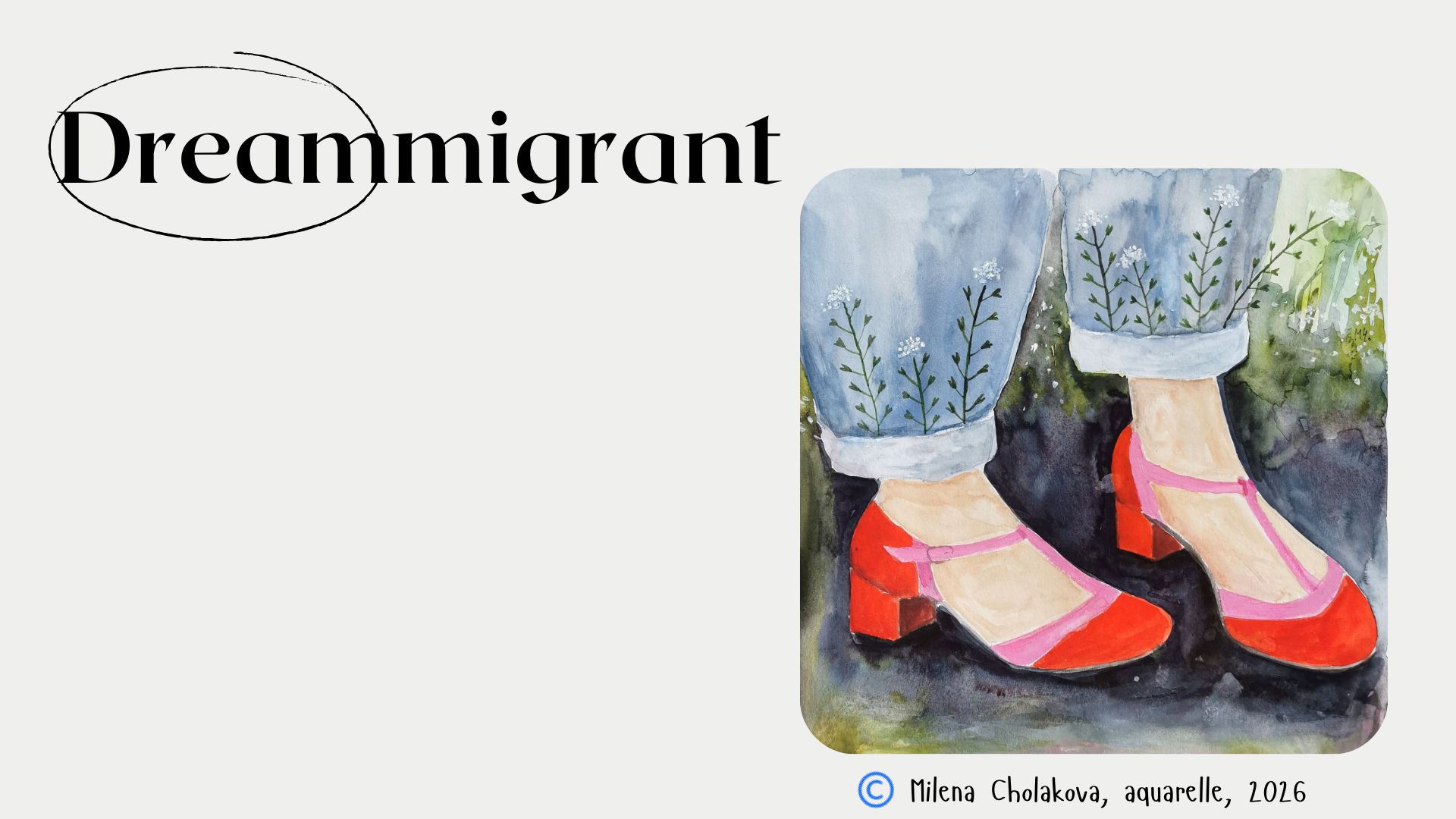
I have been living in Brussels for six years. I arrived as a wife following an expat husband – which, if we are being precise, makes me an immigrant. Although immigrant feels dramatic and expat sounds a little too polished for what I actually experience. The truth is somewhere in between, which is my point. And I call my experience:
DREAMMIGRANT
Someone who arrives established and does not start from scratch, but continues the journey. Both of life and career.
Since early 2026, I have been conducting one-hour interviews with people living abroad, most of them in Belgium and Western Europe, for my Culture and Strengths Lab initiative. After around 30 conversations so far, some patterns are already emerging.
- People who struggle in their living-abroad experience tend to focus on what is different. They (too often) look for signs of belonging. They compare. They see their old life and their new life as two separate, competing realities.
- People who thrive abroad do something different. They do not compare or perhaps – they simply do not need to. They hold both worlds without ranking them. “I miss my friends at home AND I am building something real here. This culture is unfamiliar AND it is teaching me things my home never could.”
That little word again.
Three Things to Take With You
Our brains love a list of three. Here are mine.
1. Think AND.
Black and white are elegant. Classic. But the outfit only becomes interesting when you add the colourful scarf. Or the red shoes.
Try this: take a challenge you are sitting with right now and finish the sentence not with but, but with AND.
“But” cancels. “AND” includes.
“I am stuck in my career, but I am doing my best.” (to unstuck)”.
Notice how that lands. Now try:
“I am stuck in my career, AND I am doing my best.” (to move forward)…
Something shifts. You are already closer to movement.
2. Life is a spectrum.
It is not the “fixed” position or situation you feel right now in.
Fulfilment, success, happiness – none of these are a “fixed address” you arrive at and unpack your bags. They are a number on a dial, and the dial is always moving.
If you are at a 5 out of 10 today, the question is not how do I get to 10? It is: what would move me to a 6 this week? A conversation. An experiment. A phone call. Small movement is still movement.
Thinking in spectrum is just another way of saying AND.
3. The dots connect later.
Think of something that ten years ago was a dream: a vague, slightly embarrassing, probably-not-realistic idea, that is now just part of your normal life. You have it. You earned it. You perhaps forgot you once wished for it.
The dots from today will connect later too.
Your job is not to predict exactly how. Your job is to keep showing up – with curiosity, with courage, and with that tiny word: AND.


